Acceptane-Rejection Sampling Method
Acceptance-rejection is a technique for building generators of distributions, which works well both on continuous and discrete random variables. The general idea is analogous to throwing darts at a dartboard. Consider a continuous random variable \(x\) distributed in \([a,b)\) with a proba- bility distribution \(P_x(x)\). We select a value \(P^{max}_x(x)\) with the condition
$$ P^{max}_x \ge P_x(x) $$
for all \(x\). There are four steps that the scheme selecting a random value for \(x\):
- Generate a trial value \(x_{try} = a + (b-a)R_1\), where \(R_1\) is a uniform random number between \(0\) and \(1\).
- Compute the probability density at the trial point \(P(x_{try})\).
- Accept \(x_{try}\) as the generated random number if $$ \frac{P(x_{try})}{P^{max}_x} \ge R_2 $$ where \(R_2\) is another independent uniform number.
- If this condition is not satisfied, \(x_{try}\) is rejected, and we return to step 1 and try again.
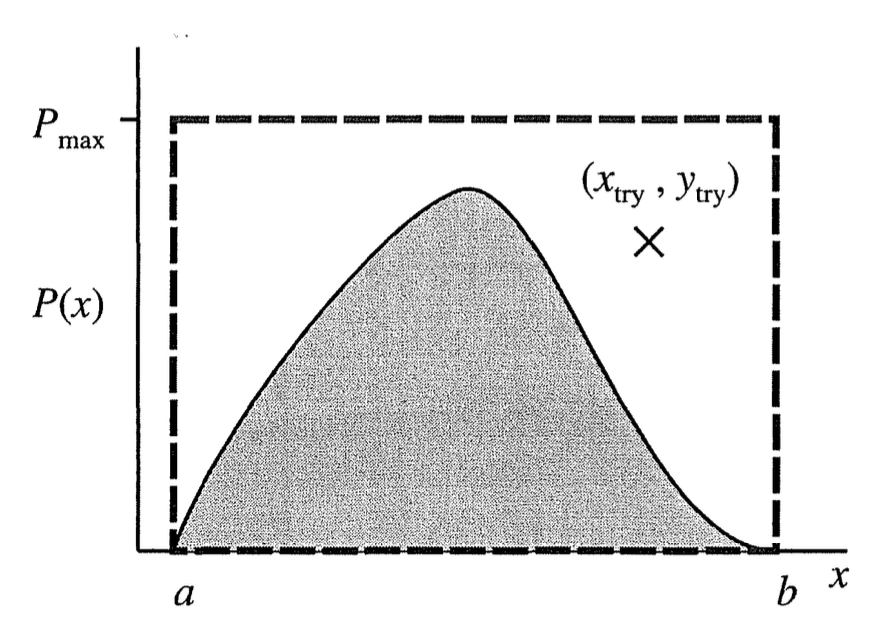
The figure shows a geometric interpretation of this scheme. Picture a rectangle bounded by \(x=[a,b)\) and \(y=[0,P_x^{max})\). We select a random point \((x_{try}, y_{try})\) inside this rectangle, where \(y_{try}=P^{max}_x R_2\). If this point lands in the shaded region, below the curve \(P_x(x)\), then it is accepted. The larger the rejection scheme is exact if \(P^{max}_x\) satisfies \(P^{max}_x \ge P_x(x)\). However, it is most efficient when \(P^{max}_x = max(P_x(x))\), since this minimizes the number of rejections.
This method also extends easily to discrete distributions. We can simply replace the curve with a histogram.
🔗 See more details here.
Examples
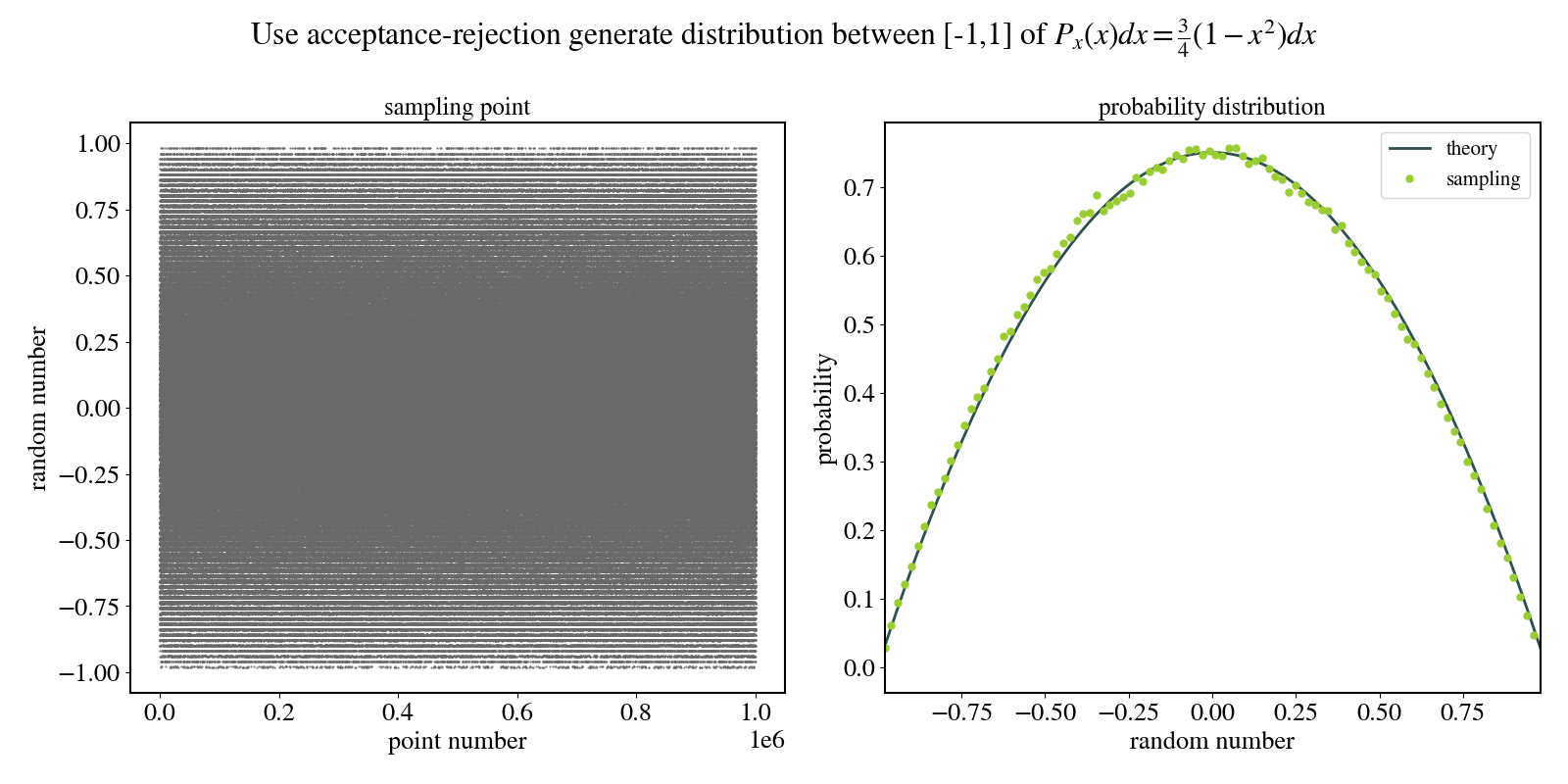
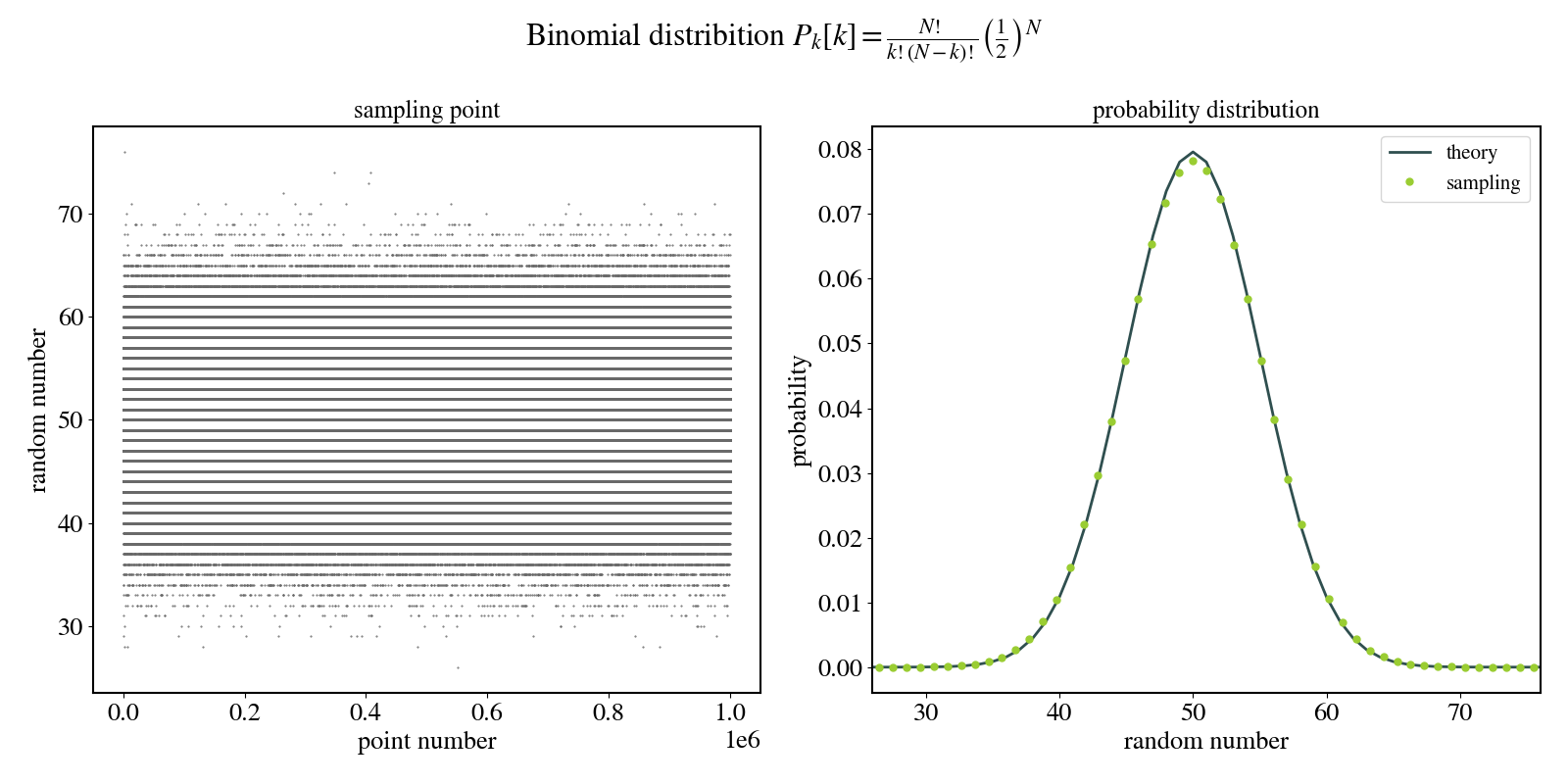
Test the method by generating \(10^6\) samples using the acceptance-rejection method. The left plot shows the accepted sampling points. The right histogram confirms good agreement with the target distribution.
- Use acceptance-rejection to generate the distribution $$ P_x(x)dx = \frac{3}{4}(1-x^2)dx $$ where \(-1 \le x \le 1 \).
- Use binomial distribution $$ P_k[k]=\frac{N!}{k!(N-k)!} \left(\frac{1}{2}\right)^2 $$ where \(k=0,…,N\).
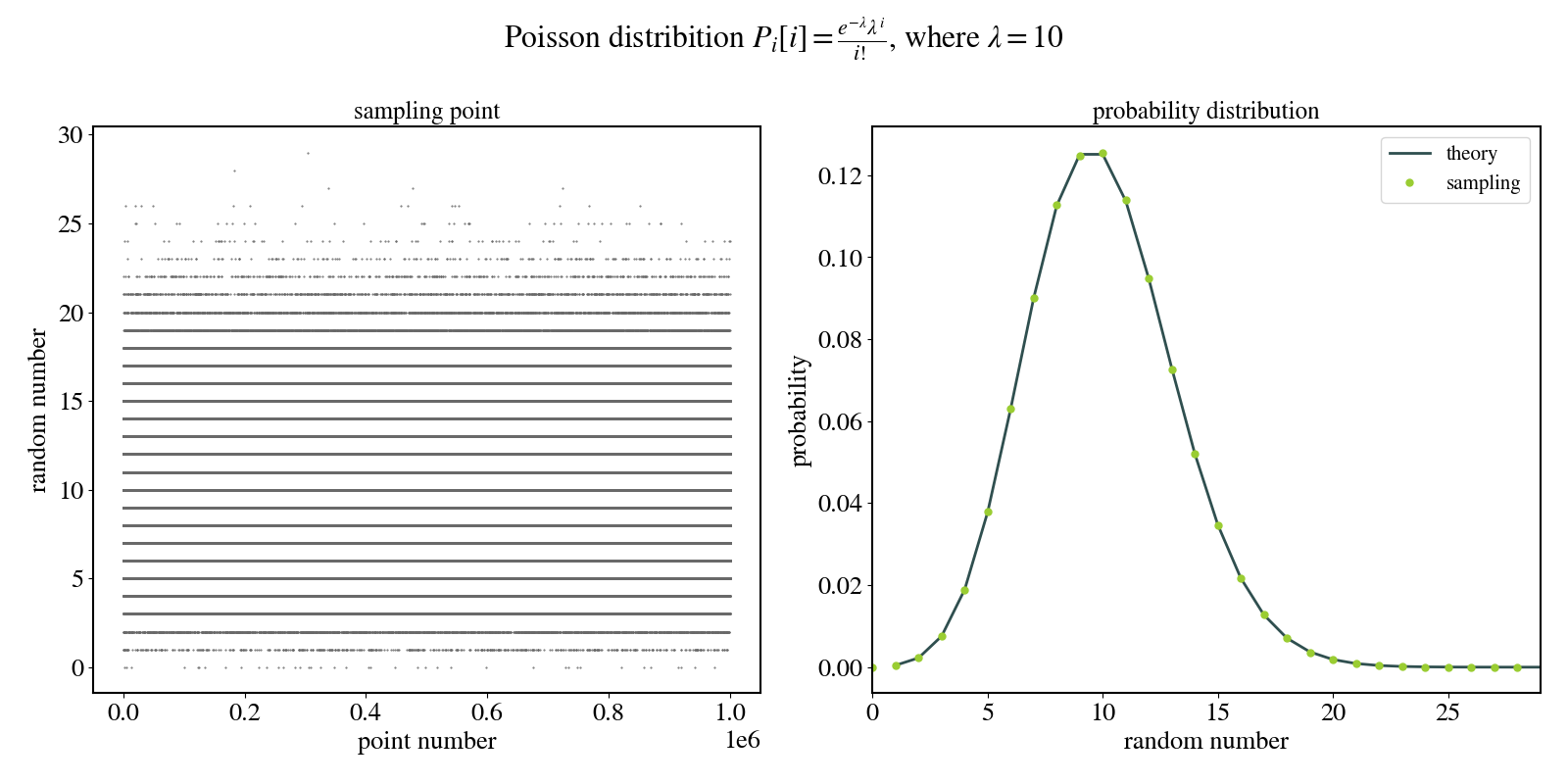
3 Use Poisson distribution $$ P_i[i]=\frac{e^{-\lambda} \lambda^i}{i!} $$ where \( 0 \le i \le \infty \) and \(\lambda=10\).