In Rutherford’s historic experiment , alpha particles were observed to scatter when passing near the gold nuclei in a thin foil. This experiment disproved the plum pudding model and provided strong evidence for the existence of a small, dense atomic nucleus.
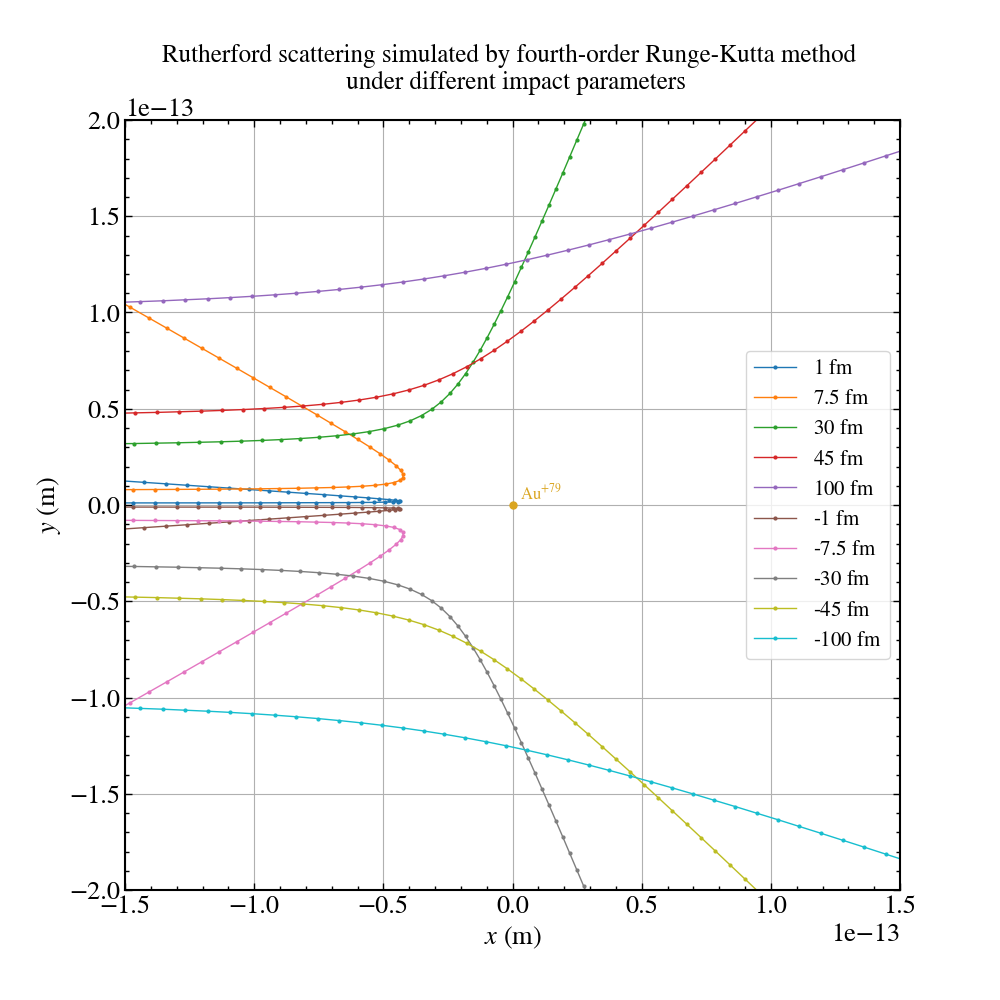
In this project, I recreated the scattering process using a numerical simulation of the Coulomb force between an alpha particle and a gold ion. The simulation is solved using the adaptive Runge-Kutta method, which provides high accuracy when modeling the particle’s trajectory under the influence of electrostatic repulsion.
To verify the correctness of the simulation, I compared the results with the analytical theoretical solution for Rutherford scattering, showing good agreement between the two.
🔗 See more details here.
Governing equations
Rutherford scattering describes the deflection of a charged particle (such as an alpha particle) due to the Coulomb force exerted by a heavy nucleus (such as gold). The equation of motion for the alpha particle is given by: $$ \vec{F}=\frac{q_{\alpha}q_{Au}}{4\pi \epsilon_0} \frac{\vec{r}}{|r^3|}=m_{\alpha}\frac{d\vec{v}}{dt}. $$
Here:
• \(q_\alpha\) and \(q_{Au}\) are the charges of the alpha particle and the gold nucleus, respectively,
• \(\vec{v}\) is the displacement vector from the gold nucleus to the alpha particle,
• \(m_\alpha\) is the mass of the alpha particle, and
• \(\epsilon_0\) is the vacuum permittivity.
Since the simulation involves motion at the atomic scale, applying appropriate normalization and unit conversion improves numerical stability and accuracy.
Theoritical solution
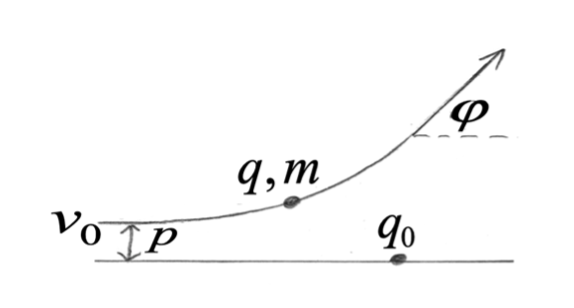
The theoretical solution of Rutherford scattering is $$\tan{\frac{\varphi}{2}}=\frac{p_0}{2p},$$
where
• \(\varphi\) is the scattering angle,
• \(p\) is the impact parameter (the perpendicular distance from the initial trajectory to the center of force),
• \(p_0\) value corresponds to the distance at which all kinetic energy is converted into electrostatic potential energy
$$p_0=\frac{1}{4\pi\epsilon_0}\frac{2qq_0}{mv_0^2}.$$
Simulation Result
Numerical trajectory of alpha particle using adaptive Runge-Kutta method